Military helicopter crash near Cyprus
Down Cemetery RoadThe Military helicopter crash near Cyprus is the reported death of Thomas Singleton, a soldier whose loss left his wife a widow before their daughter Dinah Singleton was born. At first it appears to be a distant military tragedy, relayed as settled local knowledge. Joe Silvermann’s account complicates that certainty: no body was recovered, and a policeman who disclosed details soon urged Joe to forget the conversation. The crash matters not only as a family bereavement but as the point where an official death story meets evidence of deliberate silence.
Reported Circumstances
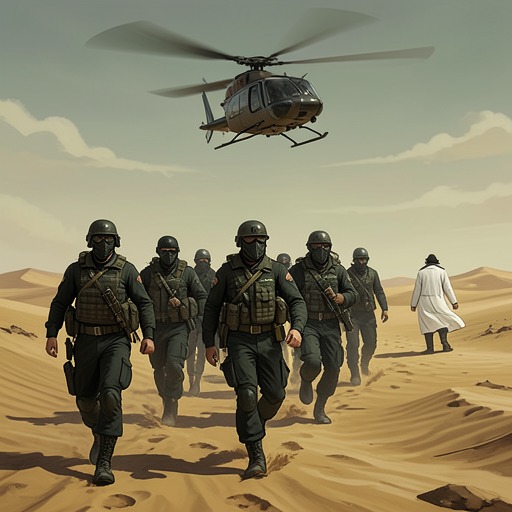
Wigwam first explains the Singleton family to Sarah Trafford by saying that Dinah’s husband—meaning Dinah’s father, Thomas Singleton—had been killed several years earlier. Her account is casual and uncertain in its particulars. Thomas had been a soldier who fought in the Gulf War, but Wigwam distinguishes the crash from that conflict: he died in an accident involving a helicopter, perhaps in Cyprus. She remembers that several soldiers were killed and that the event occurred four years earlier, before Dinah was born. The family had moved to South Oxford afterward, so Wigwam had not known Thomas personally; her knowledge is second-hand rather than eyewitness testimony.
Joe Silvermann later supplies a more specific version while discussing Thomas with Sarah. He identifies him as a soldier who fought in the Gulf War, then places his reported death off Cyprus in a helicopter crash about four years before the conversation. Joe says that six people died altogether among the soldiers aboard, in addition to the crew. His estimate gives the incident a larger scale than Wigwam’s brief account, while retaining the same central details: the military setting, the location near Cyprus, and the separation between the crash and the Gulf War itself.
The Missing Body and the Unsettled Death
The decisive complication is that the helicopter’s occupants were reportedly killed, but Thomas’s body was never recovered. Joe emphasizes this absence in response to Sarah’s question about how Thomas died the first time. He treats the missing body as more than an incidental detail: it gives force to his dry observation that reports of Thomas’s first death had been greatly exaggerated. The wording makes the official account sound less final than the neighborhood version Sarah had heard.
Sarah recognizes the implication without being given a complete explanation. Her answer connects the missing body to the possibility that its recovery would have been embarrassing in retrospect. The exchange does not establish what happened to Thomas after the crash, nor does it explain how or why the original report was made. It does, however, change the status of the story: what Wigwam had passed on as a husband killed in service becomes a reported death whose central physical confirmation is absent. The distinction between a person presumed dead and a body actually recovered is left conspicuous.
Inquiry and Information Clampdown
Joe’s information comes through a policeman, not through a public report. He says that the officer spoke in exchange for a donation to a charity of the officer’s choice, then warned Joe that the information was for his ears only. Two hours after their conversation, the policeman telephoned again and suggested that Joe forget they had ever met; he even offered to return the donation. Joe describes that reversal as unprecedented and nearly supernatural, stressing how sharply the officer’s conduct changed after disclosing the crash details.
The policeman could not explain the reason for the pressure. He did, however, describe an information clampdown and warned that leaks would be plugged. His concern was his pension. Joe consequently tells Sarah not to expect the details to appear in newspapers. The reported crash is thus surrounded by two kinds of uncertainty: the missing body weakens the apparent finality of Thomas’s death, while the sudden effort to suppress discussion obstructs independent scrutiny. The account identifies no authority responsible for the clampdown and gives no further explanation of its purpose; its significance lies in the warning itself and in the speed with which the policeman tried to retract what he had disclosed.
Family Loss and Narrative Significance
For the Singleton family, the crash’s public meaning is clear even where its circumstances are not. Thomas is treated as a soldier killed several years earlier; his death precedes Dinah’s birth, and Maddie Singleton is left to raise their daughter without him. Wigwam’s description makes the loss part of the family’s ordinary history, while her uncertainty about the precise location and details shows how little of the event has reached the people around them. Sarah’s questions, by contrast, expose how an apparently familiar account depends on fragments of hearsay.
The event also marks a divide between private mourning and official knowledge. The family receives a settled conclusion, but Joe encounters a missing body, a guarded policeman, and a warning that the information should not be repeated. These details do not by themselves prove what happened to Thomas; they make the accepted account difficult to treat as complete. By placing the revelation inside Joe and Sarah’s conversation rather than presenting the crash directly, the narrative lets its meaning emerge through gaps, corrections, and the attempted suppression of the story. The crash is therefore both a reported military disaster and the beginning of a question about whether the reported death can be trusted.